

Sensitivity study of novel gamma-ray detectors for PET using Monte-Carlo simulation
In collaboration with the TERA Foundation and other researchers in the European project ENVISION, I carried out a sensitivity study of various PET detector geometries making use of novel front-end detector technologies.
A link to the ENVISION project can be found here.
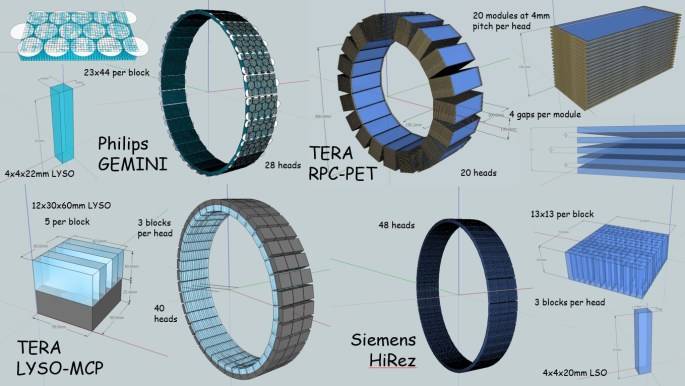
Shown below are drawings of the four different detector technologies and their geometrical arrangement in the simulated PET scanner. Two of the four are novel ideas which would benefit from Time-of-Flight PET techniques. The Philips GEMINI and Siemens Hi-Rez were also simulated as benchmarks for comparison of performance and simulation validation.
Below are links to publications made as an outcome of this work:
- “Development of TOF-PET detectors based on the Multi-Gap Resistive Plate Chambers”, U. Amaldi et al., Nuclear Instruments and Methods in Physics Research A, 778 (2015), pp 85-91, 10.1016/j.nima.2015.01.018
- “Evaluation of Resistive-Plate Chamber-based TOF-PET applied to in-beam Particle Therapy Monitoring”, I. Torres-Espallardo et al., Physics in Medicine and Biology, 60 (2015) N187-N208, 10.1088/0031-9155/60/9/N187
- “Detectors for Quality Assurance in Hadrontherapy“, D. A. Watts, PhD dissertation, Universita Autonoma de Barcelona, 2014, hdl.handle.net/10803/133354
- “The use of multi-gap resistive plate chambers for in-beam PET in proton and carbon ion therapy”, D. Watts et al., Journal of Radiation Research, 2013, 54, il36-il42, 60 (2015) N187-N208, 10.1093/jrr/rrt042
- “A compact Multi-gap RPC Detector for TOF-PET”, F. Sauli et al., ICTR-PHE Conference Record, March 2012, 10.1016/S0167-8140(12)70050-6
- “Comparison Study of RPC and Crystal Based PET Systems for Hadron Therapy Monitoring”, F. Diblen et al., IEEE Nuclear Science Symposium Conference Record, 2012, 10.1109/NSSMIC.2012.6551504
A proton range telescope for proton radiography
In collaboration with the TERA Foundation, a proton range telescope was developed and tested to measure the residual range of protons emerging from a patient receiving proton therapy. For more information our site for more information on proton therapy.
Proton radiography, though not currently used in mainstream clinical practice, can yield anatomical information with a much lower dose to the patient. Its relevance lies in further improving the conformity of the treatment plan to the tumor volume, leading to better sparing of healthy tissues.
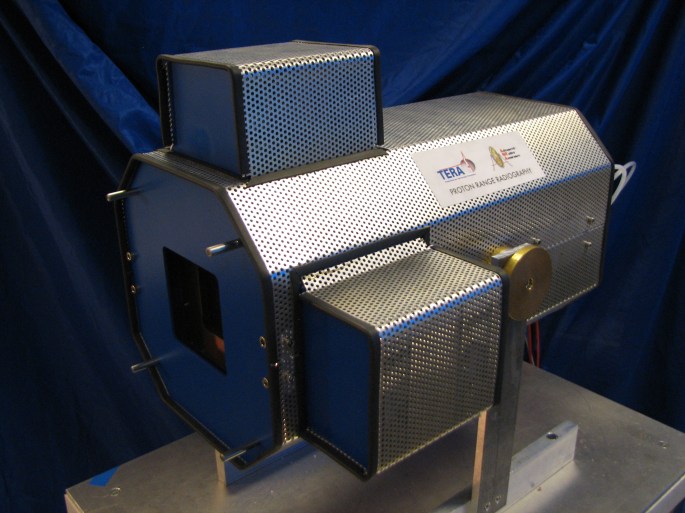
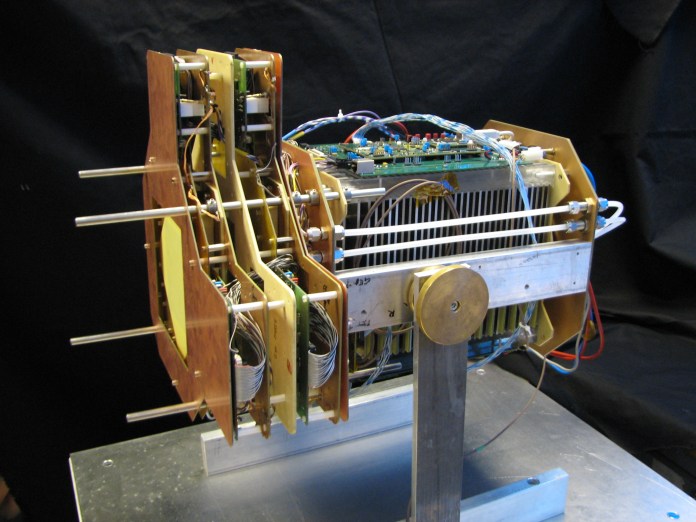
Shown below is the proton radiography instrument without the final cover. Visible are the two GEM (Gas Electron Multiplier) detectors used to track the emerging protons and the stack of plastic scintillators for determining the proton range.
The following is list of publications about the TERA proton range telescope:
- “Development of a fast proton range radiography system for quality assurance in hadrontherapy“, M. Bucciantonio et al., Nuclear Instruments and Methods in Physics Research A, 732 (2013) 564-567, 10.1016.j.nima.2013.05.110
- “Construction, test and operation of a proton range radiography system“, U. Amaldi et al., Nuclear Instruments and Methods in Physics Research A, 629 (2011), pp 337-344, 10.1016/j.nima.2010.11.096
- “Detectors for Quality Assurance in Hadrontherapy“, D. A. Watts, PhD dissertation, Universita Autonoma de Barcelona, 2014, hdl.handle.net/10803/133354
- “Advanced Quality Assurance for CNAO“, U. Amaldi et al., Nuclear Instruments and Methods in Physics Research A, 617 (2010), pp 248-249, 10.1016/j.nima.2009.06.087
- “A Proton Range Telescope for Quality Assurance in Hadrontherapy,” 2009 IEEE Nuclear Science Symposium Conference Record, 10.1109/NSSMIC.2009.5402303
Field Gradient Lattice Detector
The Field Gradient Lattice Detector (FGLD) was developed in conjunction with CERN, the European Center for Nuclear Research, in Geneva, Switzerland.
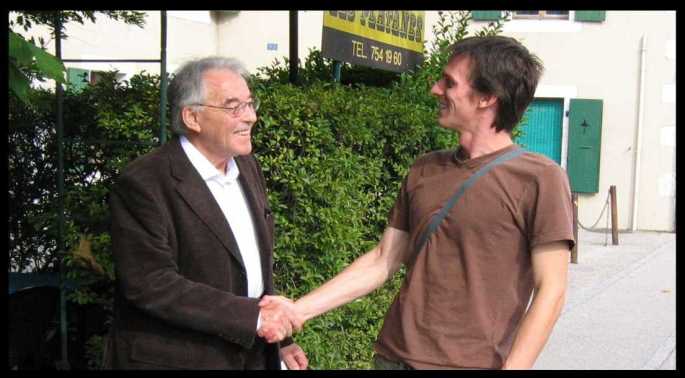
The detector, invented by Dr. Louis Dick and Rui de Oliveira of CERN, is a unique type of Micro-Pattern Gas Detector (MPGD). Housed in a gas chamber containing an Argon-CO2 mixture and operated in proportional mode, it allows an accurate detection of ionizing radiation. The FGLD detector has applications in medical, industrial or space applications.
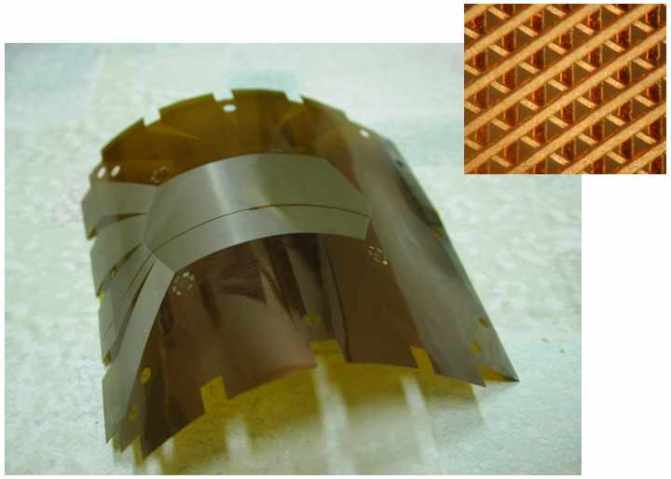
Shown below is a picture of the FGLD detector foil and a microscope view of the active area which provides gas amplification of the electron-ion pairs produced by the ionizing radiation.
The detector is made of two layers of polyimide film and is flexible, opening the possibility for cylindrical or even spherical detector geometries.
Publications:
- FGLD publications
- Evaluation of the Field Gradient Lattice Detector, D. A. Watts, DEA thesis, Universita Autonoma de Barcelona, 2008
- FGLD: a novel and compact micro-pattern gas detector, Nuclear Instruments and Methods in Physics Research A, 535 (2004), pp 347-351
Links:
- Original FGLD presentation, CERN, 2004
- FGLD website, hosted at CERN
- CERN Courier Obituary of Louis Dick, Oct 27th, 2014
The Particle Physics Card Game
Here’s a link to a new project I’m working on independently.
 Purcell Physics