

Proton therapy is an advanced form of radiotherapy which uses protons beams to target and destroy cancer tissues inside the body [1].
Proton therapy is similar in many ways to conventional radiotherapy, except that a proton beam is used to deliver the ionizing radiation to the tumour site rather than X-rays or gamma-rays beams (technically photons).
Due to the physics of how protons interact in matter, the energy they carry can be targeted more directly onto the tumour site as compared to photons. This leads to a better sparing of healthy tissues and a better outcome for patients.
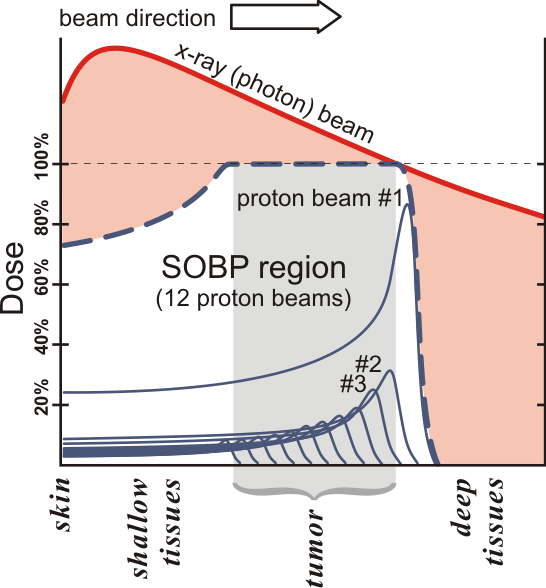
This intrinsic advantage of proton therapy is important for complicated tumour sites, especially those in the vicinity of sensitive organs-at-risk and for children where the sparing healthy and developing tissues from unnecessary radiation exposure is of the outmost importance.
Below is an example of a treatment plan which compares photons/X-rays (left) and protons (right) to treat a case of nasopharyngeal carcinoma.
[REF: Image by Taheri-Kadkhoda et al. Radiation Oncology 2008 3:4 doi:10.1186/1748-717X-3-4 [CC BY 2.0 (https://creativecommons.org/licenses/by/2.0)%5D, via Wikimedia Commons]

A brief background on Proton Therapy
The use of protons in treating cancer is not a new idea.
In 1946, Robert Wilson, a famous American physicist, recognized the advantages of protons in treating cancer and published his seminal paper on the subject, entitled, “Radiological Use of Fast Protons” [Radiology 1946:47:487-91].
In the years following Wilson’s paper (1950s), a select group of cancer patients were treated with protons, most notably in the Berkeley Radiation Facility in the United States, and at Uppsala University, in Sweden. Other high-energy physics institutes followed, having the capability to accelerate and deliver beams of protons in a clinical setting, testing the ideas of Wilson and the promise of proton therapy.
Since its first use in experimental physics laboratories, spanning the years between 1954 and 2016, proton therapy has been used to treat over 149,000 cancer patients.
As of August 2018, there are currently 70 proton therapy centers in operation, 42 in construction, and 24 in the planning stage [2].
Because of its inherent physical benefit in treating cancer over X-rays, proton therapy continues to grow, to be available to patients, and to be accepted in routine clinical practice.
This page provides a resource for anyone interested in proton therapy and its application in fighting cancer.
Proton therapy links, cancer and patient statistics:
[1] Proton therapy – Wikipedia
[2] Proton Therapy Co-operative Group (PTCOG) – Home Page
Global Cancer Observatory: Globocan 2012 – Home
World Health Organization’s cancer page: WHO | Cancer
The National Association for Proton Therapy
Proton therapy centers in Canada:
- Proton Therapy | TRIUMF : Canada’s particle accelerator center
- NEWS! –> Montreal announces proton therapy project!
- NEWS! –> Ontario ups its interest in proton therapy
Proton therapy centers in US:
The following are links to operating proton therapy centers in the United States, the year indicates the date in which each center began treatment with protons.
By following the links you will find further information as to the benefits of proton therapy, as well as direct contact information for patients and family.
- Loma Linda University Cancer Center, Loma Linda, 1990
- UCSF – Proton Therapy for Ocular Tumors, San Francisco, 1994
- MGH Francis H. Burr Proton Beam Therapy Center, Boston, 2001
- MD Anderson Proton Therapy Center, Houston, 2006
- University of Florida – Proton Therapy Institute, Jacksonville 2006
- Oklahoma ProCure Proton Therapy, Oklahoma City, 2009
- Abramson Cancer Center – Roberts Proton Therapy, Philadelphia, 2010
- Northwestern Medicine – Chicago Proton Center, Chicago, 2010
- Hampton Univsersity – Proton Therapy Institute, Hampton, Hampton, 2010
- New Jersey ProCure Proton Therapy Center, Somerset, 2012
- Seattle Cancer Care Alliance – Proton Therapy Center, Seattle, 2013
- Siteman Cancer Center – Proton Beam Therapy, St. Louis, 2013
- Provision Cares – Proton Therapy, Knoxville, 2014
- California Protons – Cancer Therapy Center, San Diego, 2014
- Willis-Knighton Cancer Center – Proton Therapy, Shreveport, 2014
- Ackerman Cancer Center – Proton Therapy, Jacksonville, 2015
- Mayo Clinic – Proton Beam Therapy Program, Rochester, 2015
- Robert Wood Johnson University Hospital – Laurie Proton Therapy, New Brunswick, 2015
- Texas Center for Proton Therapy, Irving, 2015
- St. Jude Children’s Research Hospital – Red Frog Events Proton Therapy, Memphis 2015
- Mayo Clinic – Proton Beam Therapy Program, Phoenix, 2016
- Maryland Proton Treatment Center, Baltimore, 2016
- Orlando Health – Marjorie and Leonard Williams Proton Therapy Center, Orlando, 2016
- Seidman Cancer Center – UH Proton Therapy Center, Cleveland, 2016
- Cincinnati Children’s – Proton Therapy Center, Cincinnati, 2016
- Beaumont Health – Proton Therapy, Detroit, 2017
- Miami Cancer Institute – Proton Therapy, Miami, 2017
You can also find an interactive map with all the proton therapy centers in the United States here at the website of the National Association for Proton Therapy.
We hope that on this dedicated page of Purcellphysics.com/proton-therapy you find a valuable explanation of the physics behind proton therapy, especially for those wishing to better understand the principles and benefits for protons for cancer treatment.
Although the subject of proton therapy is challenging and complex, it is my firm belief that anyone can understand the principles behind the advantage of protons and gain an appreciation for their intrinsic benefit of in treating cancer.
Please feel free to contact us, leave a message, or inquire for more information on proton therapy or how we can assist you at our contact page.
 Purcell Physics